Skip to content
Français Current language : English
Start my project
Playgrounds

Our worlds

Playgrounds

Spaces designed for children, and for those who bring them: play equipment, safety surfacing, furniture and fencing, from study through to periodic inspection.

Our worlds

The standards govern the layout, not just the equipment

A playground is planned by age group before it is planned by equipment. Zones do not mix - a toddler and a ten-year-old share neither speed nor relationship to risk - impact areas are sized on the free fall height of each item, and the sightlines of accompanying adults govern the layout as much as anything else.

That last point is the most neglected. A playground where parents cannot see their children from the benches is badly designed, however compliant each piece of equipment may be: families stay for less time, and use collapses. We therefore deal with sightlines on the drawing, from the seating and from the entrances, as part of our space design.

For local authority playground design, the regulations cover the equipment, its installation and its upkeep. Three distinct obligations, which bind the operator continuously and not only at handover. We hand over the expected documents on completion, and then carry out the periodic inspections with the report an authority must be able to produce - see maintenance.

When the catalogue says nothing about the place, we draw the equipment: a theme tied to local history, a structure suited to a constrained plot, furniture echoing an existing vocabulary. That is the business of bespoke product design and manufacture, with the surface finishes and fixings that heavy use and a young public demand.

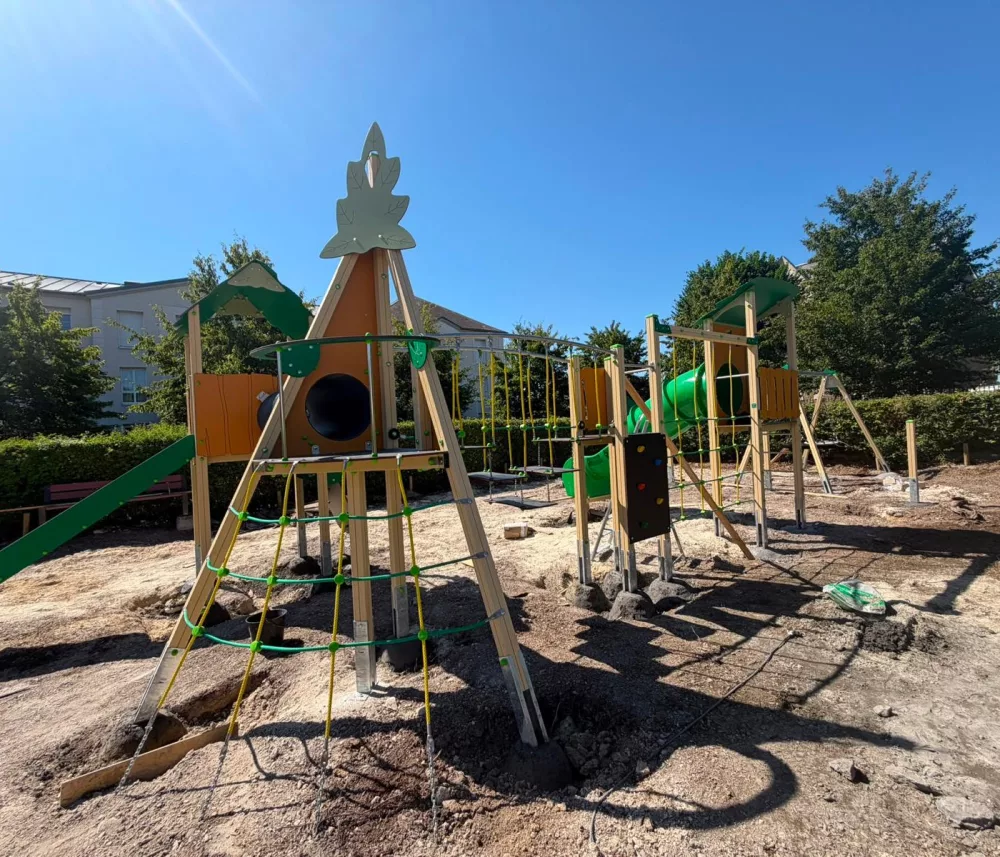
As playground installers we carry the setting out, the foundations, the laying of safety surfacing and the checking of impact areas before the public is ever let in - see installation. Delivery takes account of the real access to a park or a school yard, which is not that of an ordinary building site.

A playground frequently adjoins other facilities we handle: an outdoor games area for older children, see multi-sport spaces, with which it often shares fencing, lighting and paths. Planning both together costs less than dealing with them one after the other.

A word on programme, because it is tighter here than elsewhere. A playground is delivered for the start of a school year or for a summer season, and those dates do not move. Yet poured surfacing imposes temperature and humidity conditions that rule out laying for several weeks a year. We therefore build the programme backwards from your opening date, identifying the weather window for the surfacing as the hard point - it almost always governs the rest.

Turnkey

From concept to completion.

  1. Design

    Needs assessment and 3D modelling of the space.

  2. Equip

    Brands and equipment chosen to fit the brief.

  3. Install

    Fitted and commissioned by our own teams.

  4. Maintain

    Servicing and upkeep, built to last.

Discipline by discipline

The components of a playground in detail

Outdoor play equipment

Outdoor play equipment

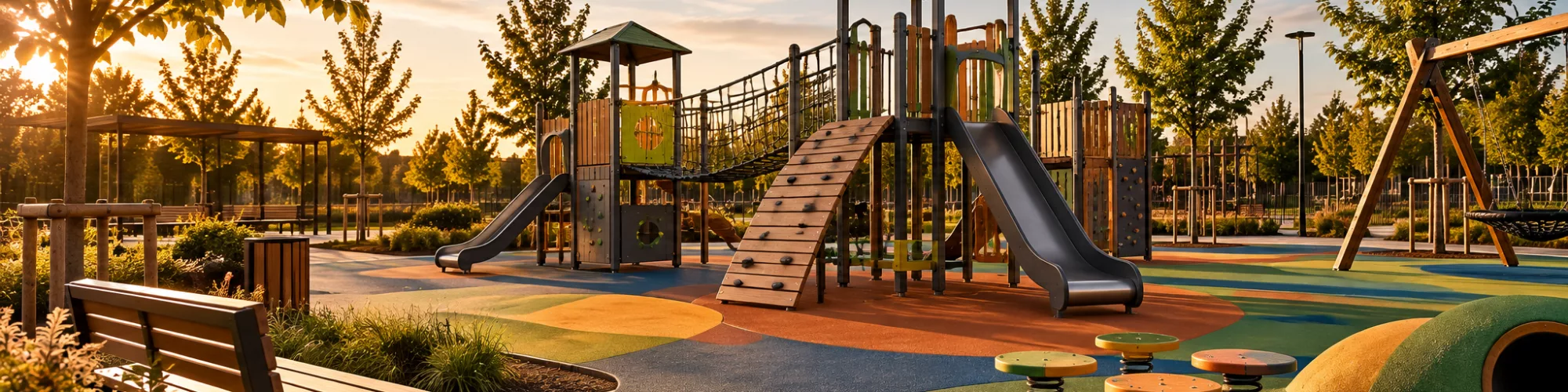
Outdoor play equipment is chosen first by age group, and it is a subtler exercise than it looks. A playground for 2-6 year-olds needs low heights, gradual access, seating and imaginative play; one for 6-12 year-olds needs height, climbing, swinging and managed risk. Mixing the two without physical separation produces a playground where the small get knocked over and the older ones are bored.

Free fall height is the figure that governs everything else: it determines the extent of the impact area, the thickness of the safety surfacing and, in turn, a large part of the budget. Equipment topping out at 1.50 metres and equipment at 2.50 metres do not cost the same once the surfacing is counted - a point catalogue comparisons systematically hide.

We work with certified equipment and with bespoke design, depending on the project. Bespoke comes into its own where the plot is constrained, where a local theme deserves telling, or where standard equipment does not sit well on a heritage site. See product design for that dimension.

On materials, timber needs regular upkeep and ages visibly but suits any setting; steel and composite need less maintenance and take intensive urban use better. We give you the ten-year upkeep cost of each option, because that is where the real difference lies, not in the purchase price.

On renewal, one mistake recurs endlessly: replacing an ageing item with a model of the same footprint but greater height, because it is more attractive. The impact area and the surfacing thickness then have to be redone, which was not budgeted for, and the playground stays closed for months. We systematically check the free fall height of the replacement model before ordering, and tell you if it forces the surfacing to be redone.
Safety surfacing

Safety surfacing

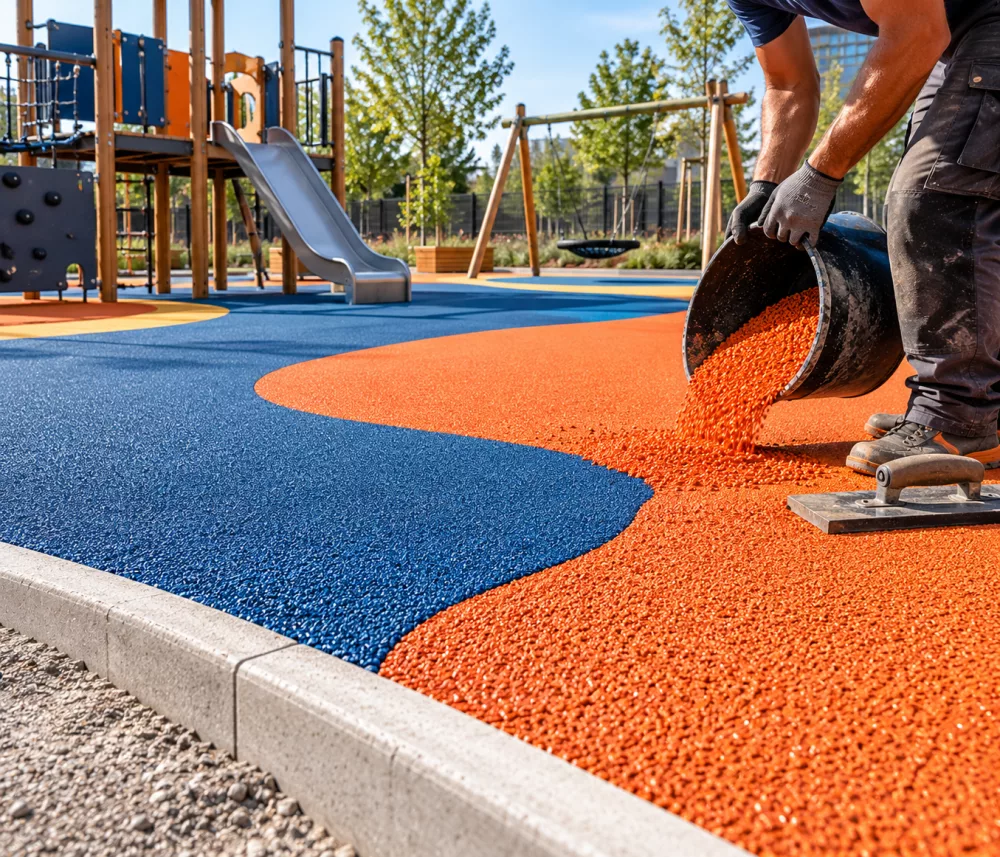
Playground safety surfacing is not a comfort finish: it is a safety device whose thickness follows from the free fall height of the tallest item in the zone. A price per square metre should never decide that thickness, and yet it is the most frequent error in the schemes we are called in to put right.

Wet-pour EPDM laid in situ is the most common urban solution: continuous, seamless, coloured, accessible to wheelchair users and easy to clean. Its laying is on a base layer whose thickness varies with the performance required, and it is that base layer, invisible once the job is finished, that does most of the absorbing.

The alternatives have their place: rubber tiles, easier to repair zone by zone; bark or sand, cheaper to buy but requiring regular topping up and constant depth checks - loose fill that hollows out under a swing loses its performance without showing it. We set out those trade-offs before the choice is made.

Junctions and edgings decide how it lasts. Poured surfacing lifting at the perimeter creates a ridge, and therefore a fall, and repairing it is expensive. We pay particular attention to the junctions between safety surfacing and paths, and between two colour zones.

A word on performance over time. Poured surfacing keeps its characteristics as long as its base layer is neither compressed nor lifting, and that is verified by periodic testing rather than by eye. Loose fill, by contrast, loses its performance as soon as its depth hollows out - under a swing, within weeks of intensive use. That is the main reason we steer authorities towards poured surfacing wherever the budget allows.

Accessibility and inclusive play

Accessibility and inclusive play

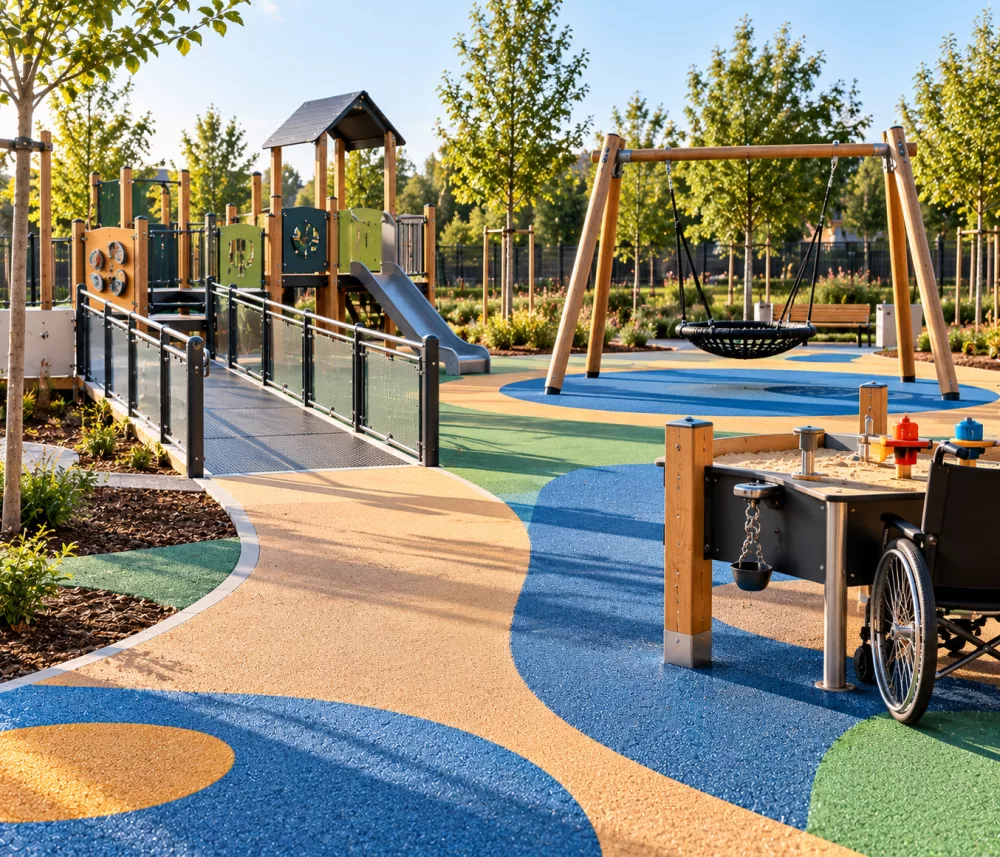
Playground accessibility is not just a wheelchair-friendly path to the gate. A genuinely inclusive playground lets a disabled child play with the others, not beside them: that is a design requirement, and it is settled on the drawing before it is settled in a catalogue.

It starts with the surface. Poured safety surfacing is wheelchair-navigable where bark or sand is not: the choice of surface is therefore, in itself, an accessibility decision. The paths then have to serve the equipment and not merely the perimeter, and thresholds between zones have to be flush.

On equipment, several answers coexist: directly accessible items - a flush roundabout, a basket swing, sand play raised to wheelchair height - and sensory play that addresses everyone without distinction. The common mistake is to install a single specific item in a corner, which isolates instead of including. We prefer to distribute them.

The adults matter too: a parent in a wheelchair has to reach the seating and see the whole playground. It is a point we check systematically on the drawing, along with sightlines. These trade-offs belong to space design, and they cost almost nothing when taken into account from the start - a great deal when added afterwards.

Furniture and shelters

Furniture and shelters

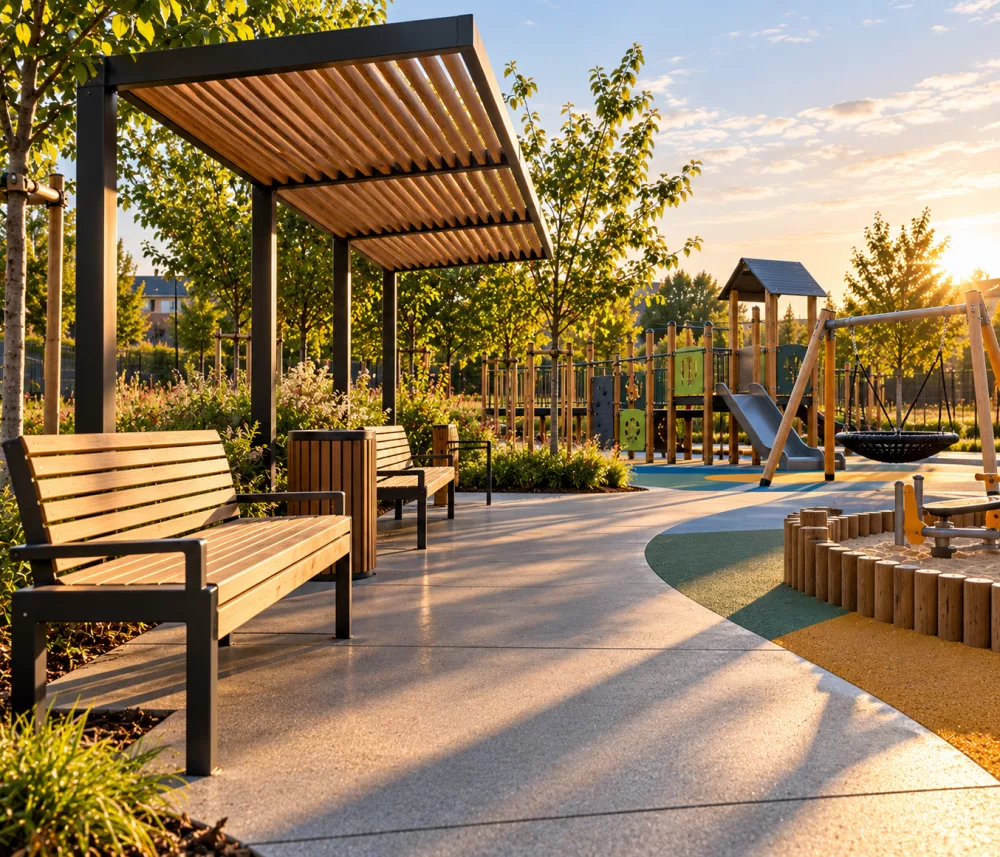
Playground furniture is aimed first at the adults who come along, and it is what decides how long families stay. Seating facing the equipment rather than the path, in sufficient number, shaded in the afternoon: three simple conditions, rarely met in the playgrounds we take over.

Shelter and shade are becoming increasingly important. A playground in full sun becomes unusable for several hours a day in summer, and dark safety surfacing reaches temperatures that rule out use. Shade is provided either by planting - the best long-term answer, but one that takes ten years - or by structures, or by the orientation of the layout. We raise the question at the study stage.

Bins, water points, buggy parking and cycle stands complete the equipment. They are modest budget items and decisive in use: a playground without bins is a dirty playground within a month, and a dirty playground empties.

We draw and manufacture this furniture where the catalogue does not suit the site - see manufacture - particularly on schemes where a municipal visual identity has to carry through to the equipment.

Fencing and boundaries

Fencing and boundaries

Playground fencing answers one priority above all: keeping the area away from the road. Everything else - separating age groups, keeping animals out, marking a boundary - comes after, and is often better handled by means other than fencing.

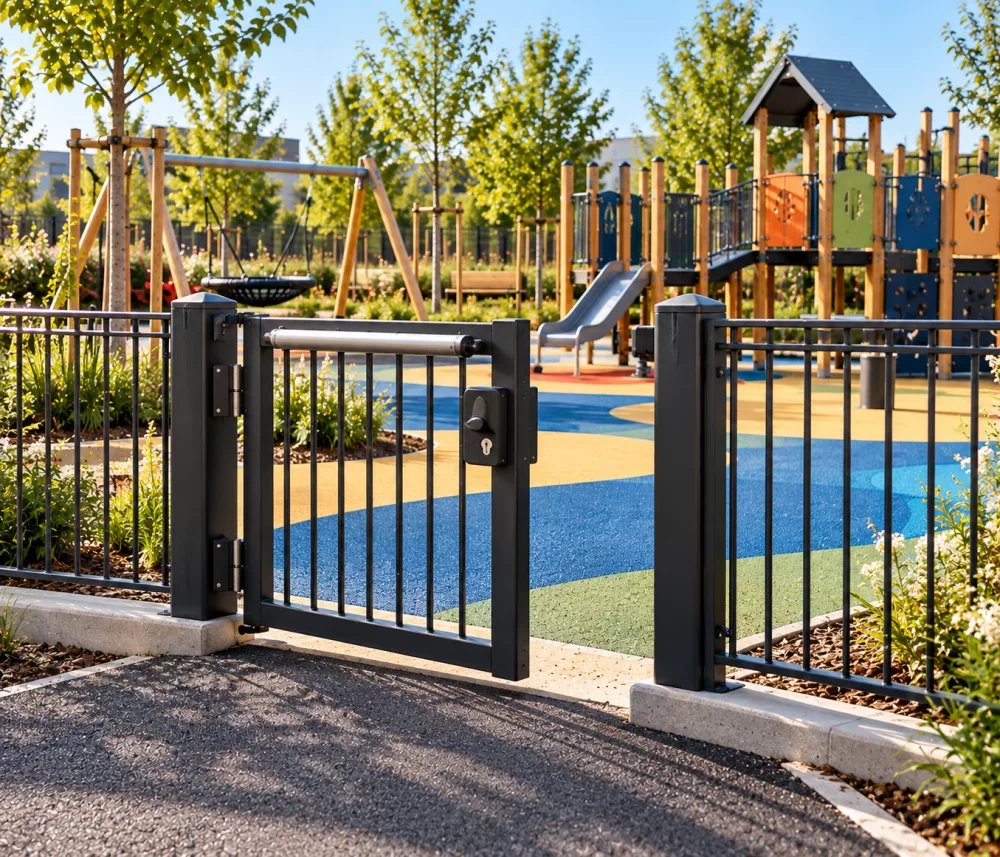
Height and infill are chosen according to the age group and the setting: a toddler area beside a road needs high fencing with a self-closing gate whose latch is out of reach; an area for older children inside an enclosed park may need only a low or planted boundary. Separating without shutting in is the balance to find.

Planted boundaries are often preferable where the context allows: visually gentler, they age better than mesh and do not suffer the same damage. They do, however, need time to establish and upkeep the authority must be able to provide.

The gate is the point most often found defective during periodic inspection: a tired spring, a broken latch, a latch height that has become reachable by a three-year-old. It is a simple, heavily used component, and we check it at every visit - see maintenance.

On vandalism, experience leads to simple choices: favour fixings that cannot be undone without a special tool, avoid components that unscrew, and remove climbing holds from the upper parts of fencing. A vandalised playground can be repaired, but what matters is that it stays safe between the damage and the repair - which is why we prefer arrangements that, when they fail, do not create a hazard.

Good to know

Frequently asked questions

Which standards does a playground have to meet?

Equipment and its installation fall under the European playground standards, and safety surfacing under a dedicated standard tied to fall height. To these are added national obligations on public playgrounds covering signage, upkeep and traceability of inspections.

We design and install within that framework, and hand over the corresponding documents at completion, which constitute your evidence of compliance.

How thick does the safety surfacing need to be?

It follows from the free fall height of the tallest item in the zone: the higher the equipment, the more the surface must absorb. It is not a budget choice but a calculation.

That is also why thickness is set after the equipment is chosen, and why replacing an item with a taller model can mean redoing the surface - something to check before any partial renewal.

Are periodic inspections compulsory?

The operator of a playground open to the public must be able to evidence maintenance and regular inspection. Lack of traceability is what turns against an authority after an accident, far more than the defect itself.

We carry out those inspections - equipment, foundations, safety surfacing, fencing and gates - and hand over a written report that serves as evidence.

What budget should I allow for a playground?

The variation comes mainly from the surfacing: on a medium-sized playground, safety surfacing frequently costs as much as the equipment itself, sometimes more where fall heights are significant.

We therefore always cost equipment, surfacing, furniture and fencing as separate lines, so you can make trade-offs - knowing that the number of items can be reduced, but never the surfacing thickness under those you keep.

Do you support local authorities before the project starts?

Yes. We come in at the study stage: zones by age group, sightlines, access, site constraints, shade. We provide the technical documents expected in a tender pack, before any contract is advertised.

That early stage is where the most expensive mistakes are avoided, because a drawing can be corrected at no cost and poured surfacing cannot.

Can an existing playground be refurbished without replacing everything?

Often, yes. An item can be kept if its structure is sound, even where the surfacing around it has to be redone. Conversely, recent surfacing can stay in place if an item is replaced with one of equivalent height.

We start with a written survey separating what can be kept from what cannot, with the reasons - that document is what then justifies the trade-offs before a council.

How long does a playground project take?

Allow three to five months between sign-off and opening to the public: procurement of the equipment accounts for most of it, and poured surfacing imposes weather conditions that can delay laying by several weeks in the cold season.

We allow for that in the programme, particularly on schemes that have to be delivered for the start of a school year or a summer season.

Does a playground have to be accessible to disabled children?

New public facilities are subject to accessibility obligations, and the subject goes beyond mere compliance in any case: an inclusive playground is a better-used playground, by a wider public.

In practice it turns on the surface - poured surfacing is wheelchair-navigable, bark is not - on paths that must serve the equipment rather than only the perimeter, and on distributing accessible items rather than grouping them in one corner.

A playground to create, or to bring up to standard?

Tell us the site, the age groups you have in mind and what is already there. We will tell you what is possible, what has to be replaced first, and what it implies in inspections afterwards.